When we think of globalization, we imagine cooperation, progress and mutual prosperity. For decades, that was the story we were told that open markets and free trade would create a balanced world economy where everyone wins. Yet, as the 21st century unfolds, we are forced to confront a harsher truth: the enrichment of China has been one of the most striking and perhaps unintended, consequences of this idealism.
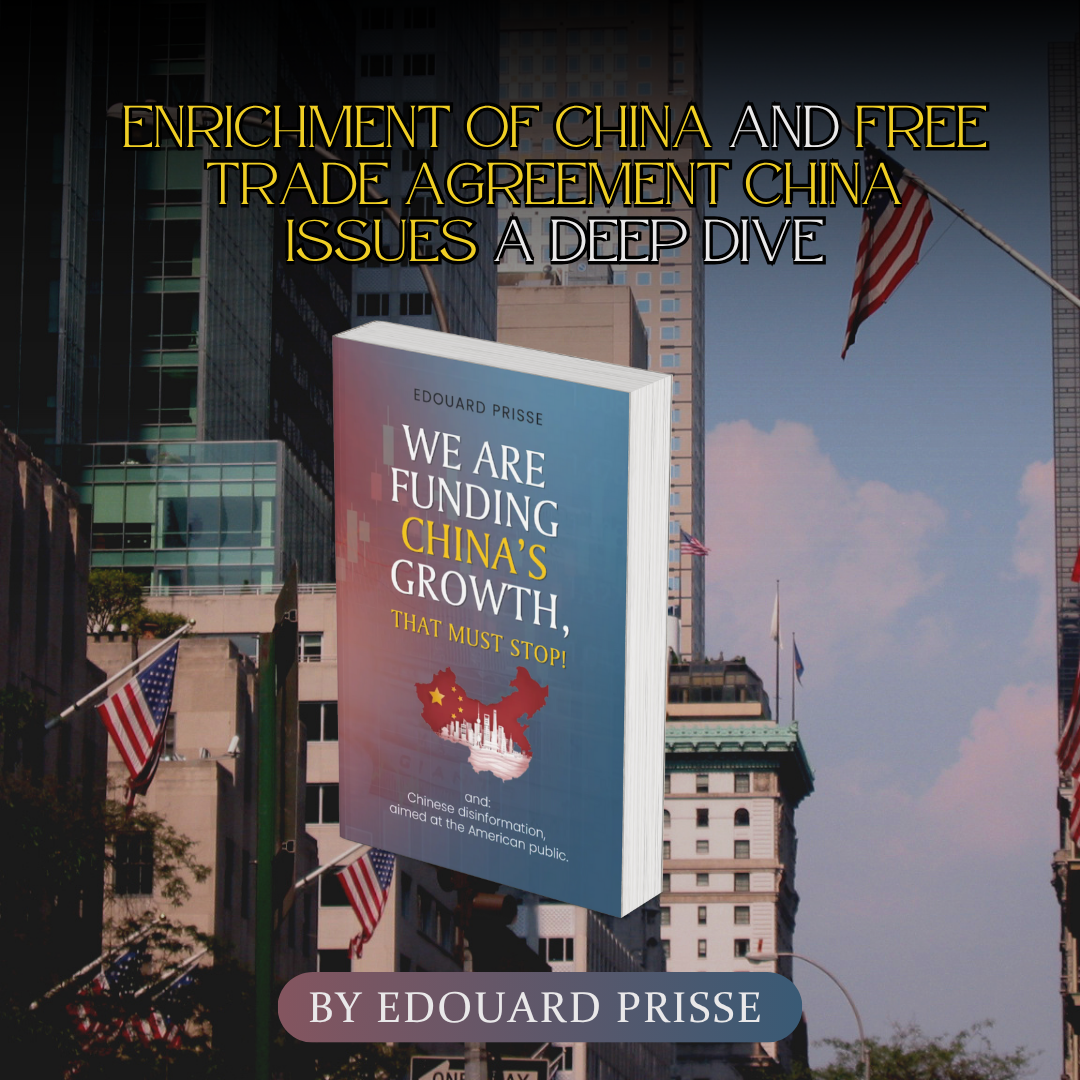
As an author and political observer, I wrote We Are Funding China’s Growth to expose this dynamic, how Western economies, through open trade and financial policies, have directly fueled China’s meteoric rise. What was once framed as economic collaboration has, in reality, become a form of financial dependency that threatens to reshape global power structures.
The free trade agreement China issues we face today are not simply about tariffs or imports; they are about the underlying systems that enable one-sided growth. In this deep dive, we will explore how trade agreements, subsidies and market access shaped the enrichment of China, why this imbalance persists and what it means for the West moving forward.
The Economic Engine of China’s Enrichment
The rise of China from a developing nation to a global superpower is often described as an economic miracle. Yet, when you look closely, it is clear that this “miracle” was engineered through a careful blend of strategy, timing and policy manipulation.
Western countries opened their markets in the name of free trade, believing this would stimulate growth on both sides. However, while Chinese exports surged, Western manufacturing declined. Industries that once powered European and American economies were dismantled and outsourced, creating a dangerous dependence on foreign supply chains.
The enrichment of China wasn’t just the result of efficiency; it was the outcome of state-led capitalism paired with Western complacency. China’s government strategically guided its industries, offering subsidies, cheap credit and protectionist policies that kept foreign competitors at bay. Western economies, meanwhile, maintained a hands-off approach, assuming that the invisible hand of the market would eventually restore balance.
But balance never came. Instead, China used the wealth generated from trade to expand its technological capacity, military strength and political influence. What we now see is not a partnership between equals but a relationship of dependency and the free trade agreement China issues at the center of this imbalance remains largely unresolved.
Free Trade Agreements with China: The Hidden Imbalance
When free trade agreements were signed with China in the late 20th and early 21st centuries, they were heralded as the dawn of a new era in global economics. The idea was that open trade would encourage fair competition and mutual growth. However, reality turned out to be far more complex and far less fair.
Western nations operated under the assumption that China would adhere to the same market principles, such as transparency, reciprocity and open competition. Yet, China never fully embraced these ideals. Instead, it leveraged the advantages of being treated as a developing economy while acting like a global powerhouse.
The free trade agreement China issues stem from this dual identity. On one hand, China demanded access to Western markets and technologies. On the other hand, it restricted foreign companies, imposed intellectual property transfers and maintained state control over key sectors.
The result? A playing field that was never level. Western businesses found themselves competing not with private Chinese firms but with the Chinese state itself. Each trade agreement, while celebrated as progress, further entrenched the enrichment of China, often at the expense of Western labor and innovation.
Even today, calls for “fair trade” are often met with vague promises and partial reforms. The fundamental issue remains that China uses free trade agreements as tools of strategy rather than cooperation.
How Free Trade Became a Strategic Weapon
Free trade is supposed to promote peace and cooperation. However, in China’s hands, it became something else entirely, a geopolitical weapon used to strengthen its influence and weaken rivals.
Through its participation in global trade systems, China positioned itself as the indispensable supplier of the world. It gained control over critical industries, electronics, pharmaceuticals, rare earth materials and more. This strategic dominance allowed Beijing to exert economic pressure when and where it wished.
For example, when diplomatic tensions arise, China can impose export bans, restrict access to essential goods or manipulate supply chains. This has made many nations cautious about criticizing Chinese policies, fearing economic retaliation. The free trade agreement China issues are not only economic in nature but also deeply political.
Meanwhile, Western economies have become addicted to the low costs that Chinese manufacturing offers. The enrichment of China thus continues not just because of trade policy but because of consumer behavior and corporate priorities. As long as profit margins outweigh long-term strategic thinking, China’s dominance will grow unchecked.
In this sense, free trade has become the very opposite of what it was meant to be: a source of dependency, not empowerment.
The Political Cost of Economic Dependency
The enrichment of China is not purely an economic issue; it is a political one. Each dollar, each investment, each trade surplus represents a shift in global influence. The more dependent Western countries become on Chinese goods and markets, the harder it becomes to take an independent political stance.
Consider how international organizations and even governments often temper their criticism of China’s human rights record or foreign policy aggressions. The fear of losing access to the Chinese market looms large. This economic leverage grants Beijing a powerful voice in global diplomacy, often louder than that of the nations that enabled its rise.
Moreover, the free trade agreement China issues have created a ripple effect in domestic politics. In many Western countries, voters have grown disillusioned with the promises of globalization. They see communities hollowed out by deindustrialization, jobs lost to outsourcing and local economies struggling to survive.
This growing frustration fuels political polarization, undermining the very democratic stability that free trade was supposed to protect. In essence, the enrichment of China has come with a corresponding impoverishment of Western unity and political coherence.
The Role of Technology and Intellectual Property in China’s Rise
One of the most overlooked aspects of the enrichment of China is how technological advancement was achieved not through pure innovation, but through strategic acquisition. Free trade agreements allowed China to attract Western corporations eager to tap into its vast market. However, in exchange for market access, many were forced to share their technology or enter joint ventures with Chinese firms.
Over time, this led to a massive transfer of intellectual property. China’s tech sector grew at an unprecedented pace, bolstered by state funding and foreign expertise. Today, China is a leader in fields such as artificial intelligence, telecommunications and renewable energy, all powered by knowledge and resources that originated in the West.
The free trade agreement China issues, tied to intellectual property theft and unfair competition, have become central concerns for policymakers. Yet enforcement remains weak. As long as multinational corporations prioritize short-term profits, China’s ability to exploit these gaps will persist.
This dynamic has made innovation itself a double-edged sword. Each breakthrough shared in the name of collaboration further strengthens China’s global position, sometimes at the direct expense of the nations that created it.
Lessons from “We Are Funding China’s Growth”
In my book We Are Funding China’s Growth, I take readers through the historical and political evolution of this imbalance. My goal was to reveal not just how the West financed China’s rise, but why it continued doing so even as the risks became clear.
The answer lies in a blend of economic ideology and political naiveté. Western leaders believed that trade liberalization would naturally lead to democratization in China. Instead, China proved that it could embrace capitalism without surrendering control. The result is a hybrid system, one that exploits the openness of others while maintaining its own rigidity.
The enrichment of China is therefore both a product of strategy and of Western self-deception. The free trade agreement China issues serve as case studies in how optimism can turn into exploitation when the rules of engagement aren’t enforced equally.
My book calls for awareness, accountability and reform. If we want a fairer global economy, we must first understand how we helped create the imbalance we now face.
Rethinking Free Trade: Toward a Fairer Future
The conversation about free trade cannot remain stuck in the 1990s. It is time to move from blind faith in globalization to strategic realism. That doesn’t mean abandoning trade; it means redefining its principles.
First, nations must implement stricter standards for reciprocity. If China demands open access to foreign markets, it must be required to offer the same level of openness in return. Second, governments should protect strategic industries and enforce rules against intellectual property theft.
Transparency is another key factor. Trade agreements should be clear, enforceable and designed to prevent manipulation. The free trade agreement China issues we see today stem largely from vague terms and weak enforcement mechanisms. Closing these gaps is essential to ensure fairness.
Finally, Western societies must reinvest in themselves, rebuilding manufacturing, encouraging innovation and supporting industries that were previously outsourced. The enrichment of China was made possible because we neglected our own economic resilience. It is time to reverse that trend.
The Global Implications: What’s at Stake
If current trends continue, the global balance of power will continue to shift in favor of China. Economically, that means Western nations will remain vulnerable to supply chain disruptions and market manipulation. Politically, it means diminished influence in international affairs.
The free trade agreement China issues highlight a deeper question: can a world built on open exchange survive when one major player refuses to play by the same rules? If not addressed, these issues will define the next century not just for China and the West, but for the entire global order.
The enrichment of China has already reshaped trade, politics and diplomacy. What happens next will depend on whether the West continues down the same path or finally learns to adapt.
Conclusion
The enrichment of China didn’t happen overnight; it was the result of decades of decisions, assumptions and misplaced trust. The free trade agreement China issues we face today are not unsolvable, but they require honesty, courage and coordinated reform.
As We Are Funding China’s Growth makes clear, the first step toward change is awareness. We must recognize how we contributed to this imbalance and how we can correct it. By redefining free trade to ensure fairness, protecting our strategic industries and holding partners accountable, we can begin to restore equilibrium.
Free trade should never mean free advantage for one side. It should represent opportunity, equality and mutual respect. Only by returning to these principles can we ensure a future where prosperity is truly shared and not monopolized by a single power.


